Referral to the Justice Council
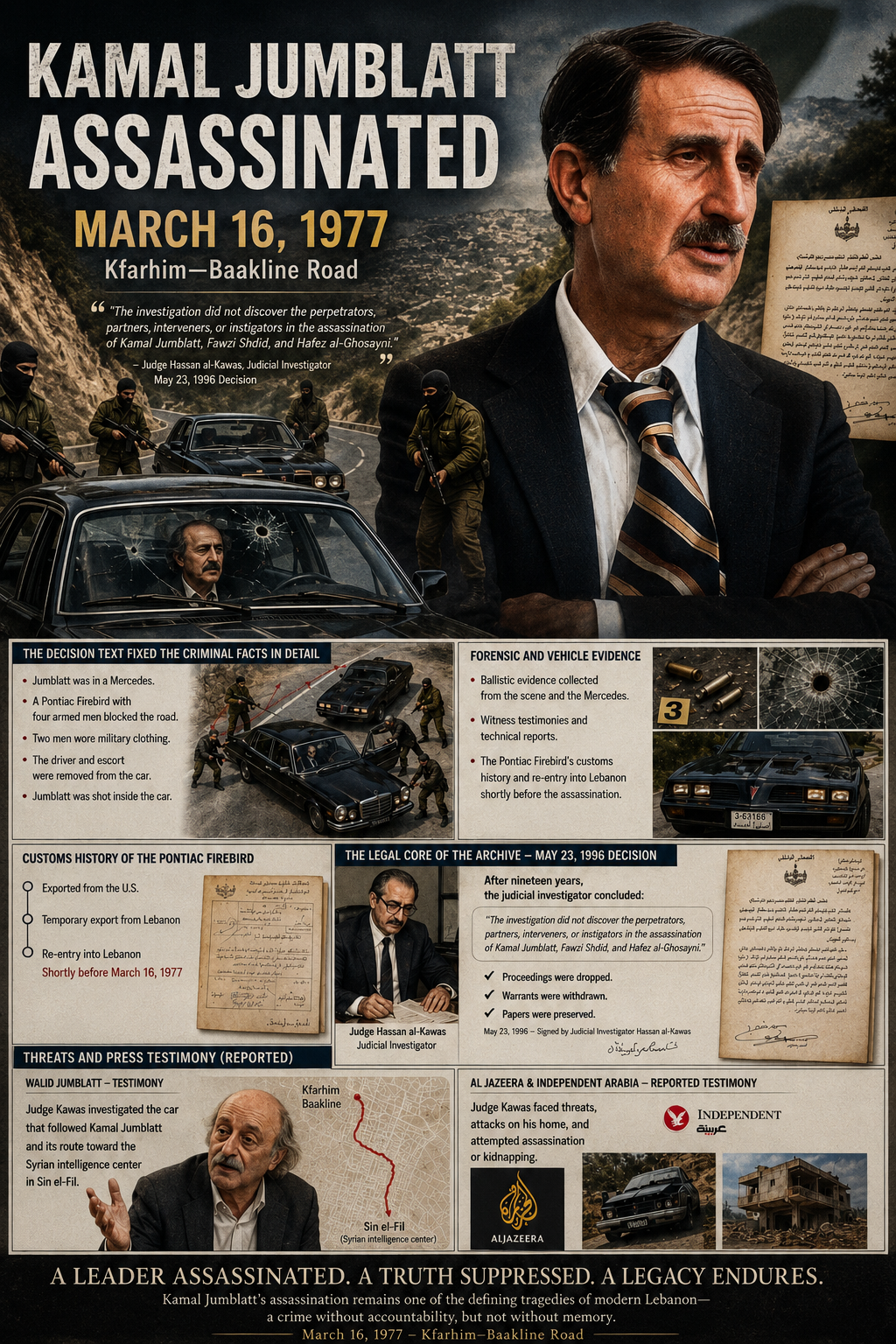
Kamal Jumblatt was assassinated on March 16, 1977 on the Kfarhim-Baakline road with Fawzi Shdid and Hafez al-Ghosayni. The case was referred to Lebanon's Justice Council on March 21, 1977.
Judge Hassan Kawas was appointed judicial investigator on March 22, 1977. The As-Safir archive later published the decision text on May 24, 1996, identifying Kawas as the judicial investigator and citing the official referral and appointment decisions.
The facts fixed by the published decision
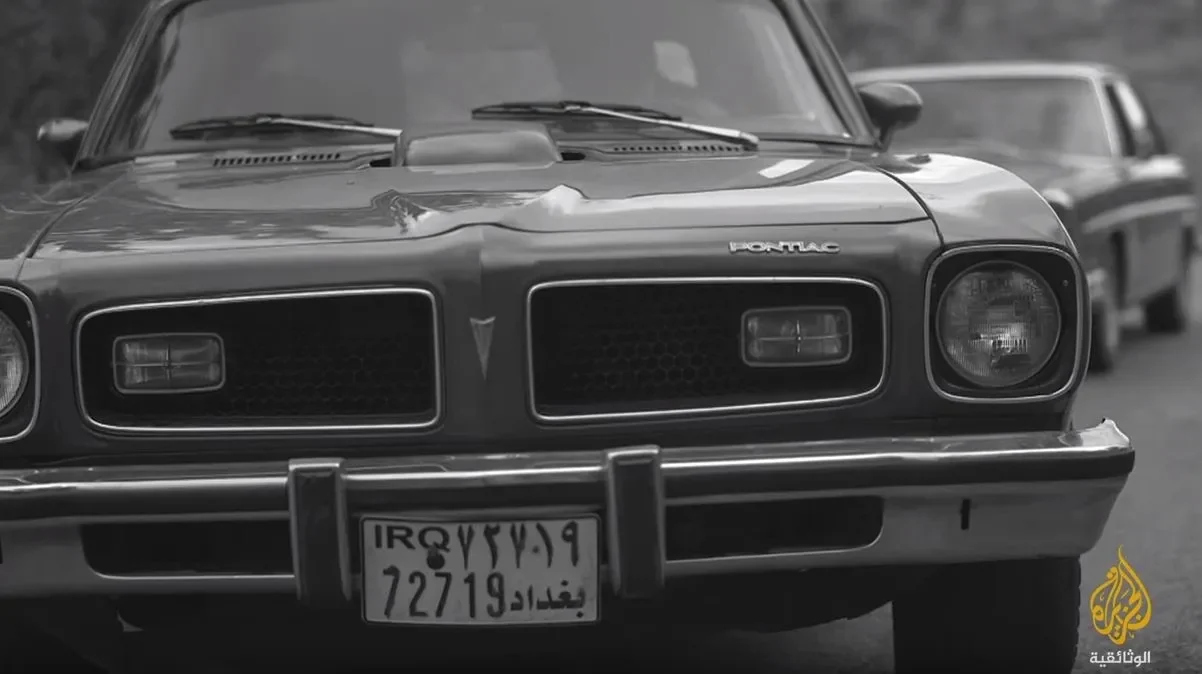
The published text fixed the criminal facts in detail: Jumblatt was in a Mercedes, a Pontiac Firebird with four armed men blocked the road, two men wore military clothing, the driver and escort were removed, and Jumblatt was shot inside the car.
The decision also recorded forensic and vehicle evidence, including the Pontiac's customs history and its re-entry into Lebanon shortly before the assassination.
The legal dead end
After nineteen years, Kawas concluded that the investigation had not discovered the perpetrators, partners, interveners, or instigators. The proceedings were dropped, warrants withdrawn, and papers preserved.
This is why the file is central to his public legacy: the decision preserved the legal record of the crime while also recording the state's failure to carry the investigation to named perpetrators.
Reported pressure on Kawas
Later source accounts describe the investigation as dangerous for Kawas and his family. Independent Arabia reports that, after his appointment, Kawas was threatened more than once, faced an attempted kidnapping, and then saw a rocket projectile fired at his home, burning it and injuring his son. The same report says the investigation had reached the identities of the four gunmen and the Syrian officer supervising the operation, Ibrahim Huweiji, linked to the Syrian intelligence center in Sin el-Fil.
Al Jazeera's documentary write-up preserves the family account: Kawas handled the investigation, and his son later recounted threats and attempted killing, including a bullet entering Kawas's bedroom, the house being burned, and an attempted assassination while Kawas was with his wife.
A more detailed kidnapping account, reported from Brig. Gen. Issam Abu Zaki's version, says two armed men in camouflage and green berets stopped Kawas near his Ras Beirut home, entered his Buick, and rode with him until Ouzai. Kawas sensed the danger, drove toward a gas station where he was known, jumped out, and workers surrounded him while the gunmen were blocked.
The heavier message, according to the same account, was an RPG fired at his house. It burned the home and injured his son Karim in the leg, reportedly causing a lifelong disability. The account adds that Karim was sent to the United States and did not return to Lebanon, while Kawas eventually left Beirut for Ainab under Walid Jumblatt's protection and his family went to America. These materials are presented as attributed testimony and press reconstruction, not as court-confirmed findings.
Lebanon News Online and the documentary reconstruction
Lebanon News Online preserves Al Jazeera Documentary's investigation titled, in translation, 'Three Enemies: Which One Killed Kamal Jumblatt?' The article organizes the assassination around multiple political tracks, with the most detailed evidentiary trail focused on the Syrian Assad regime.
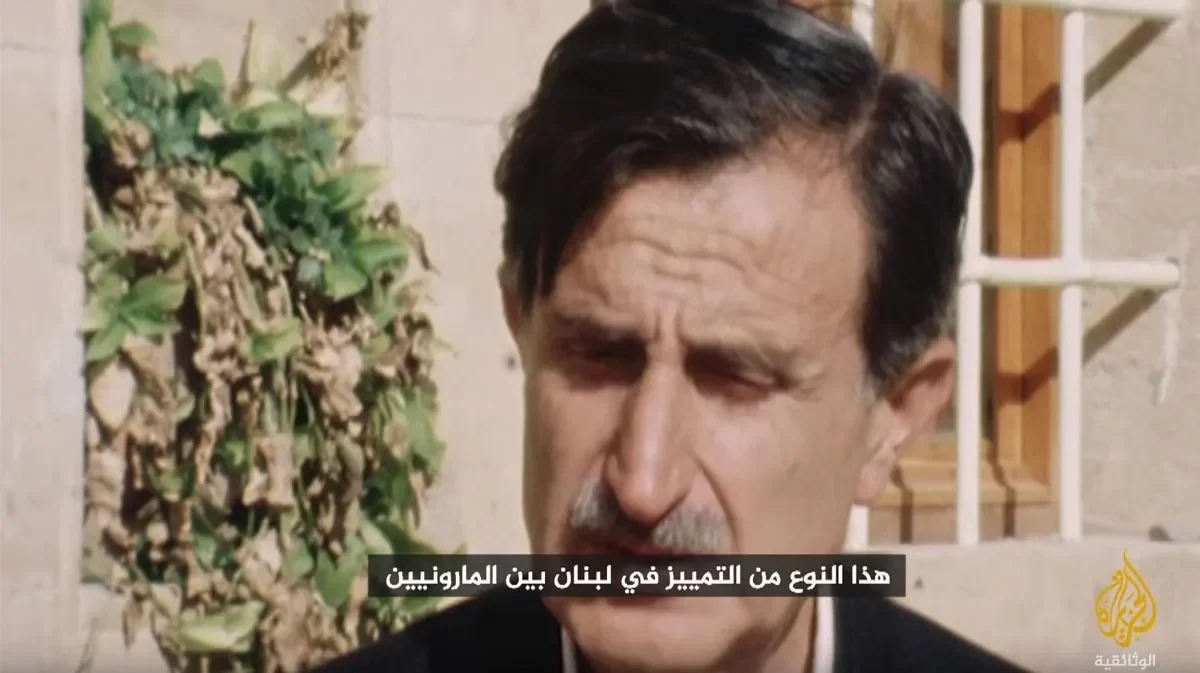
The Maronite track is presented as the local political accusation that surfaced immediately after the killing: Jumblatt had opposed Maronite dominance and stood with the Palestinian-aligned camp during the civil war. The documentary notes that this suspicion formed part of the public reaction, but says the documents and reporting it reviewed did not lead to a Maronite responsibility for the killing.
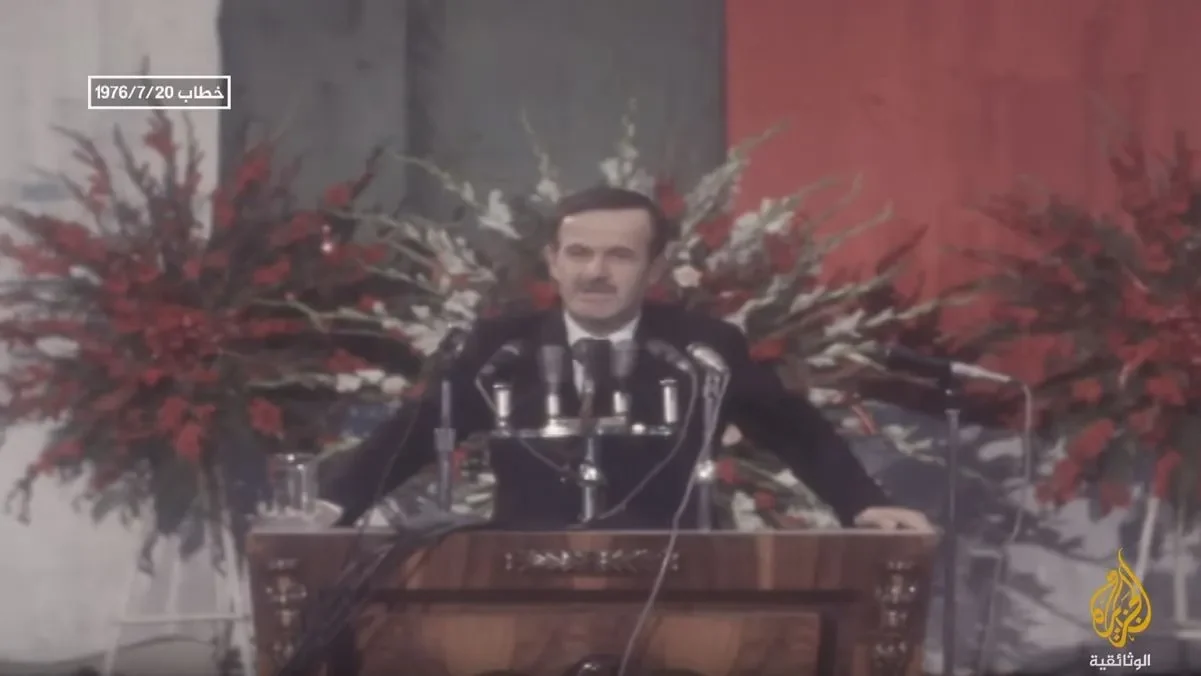
The Syrian track is the most developed. The article places Jumblatt's opposition to Syrian intervention at the center of the pre-assassination context, cites Abdel Halim Khaddam's defense of Syria's role, describes Syrian checkpoint pressure on Jumblatt, and refers to a reported U.S. intelligence warning, seven months before the killing, that the Syrians were determined to crush him.
The reconstruction then follows the crime details: a U.S.-made Pontiac Firebird carrying four armed men blocked Jumblatt's Mercedes near Baakline; the gunmen may have intended to abduct him, but the plan appears to have changed after a collision or confrontation; his skull injuries and close-range gunfire are treated as part of that analysis, while witnesses describe the gunmen killing the escorts after Jumblatt was shot.
The vehicle trail becomes the backbone of the story. The Pontiac carried Iraqi plate 72719 from Baghdad. Witness accounts place it near Syrian checkpoints, Ras Beirut General Security, and Beirut hotels including Mozart and Lorenzo. Hotel records name Hussein Kazem Jaafar Jawad, while another account mentions Saher al-Jubaili, described as linked to Syrian intelligence. The article says Iraqi civil records did not confirm Hussein's identity, while customs files showed the car had arrived from New York to Beirut and had been seized in a narcotics case before Syrian deterrent forces took custody of the car and suspects.
The final investigative path moves from the car to the alleged destination of the gunmen. A vehicle owner reportedly said armed men forced him to take them to a place later identified as a Syrian intelligence center. Local witnesses in the documentary identify the center's chief as Ibrahim Huweiji, then a Syrian officer who later became a senior air-intelligence figure. The article ends with the claim, attributed to an audio recording of Rifaat al-Assad, that Huweiji killed Kamal Jumblatt, while noting that Huweiji was close to the Syrian regime and did not answer the documentary team's call. These points are presented here as attributed documentary reporting, distinct from the court-published 1996 legal decision.