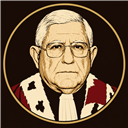
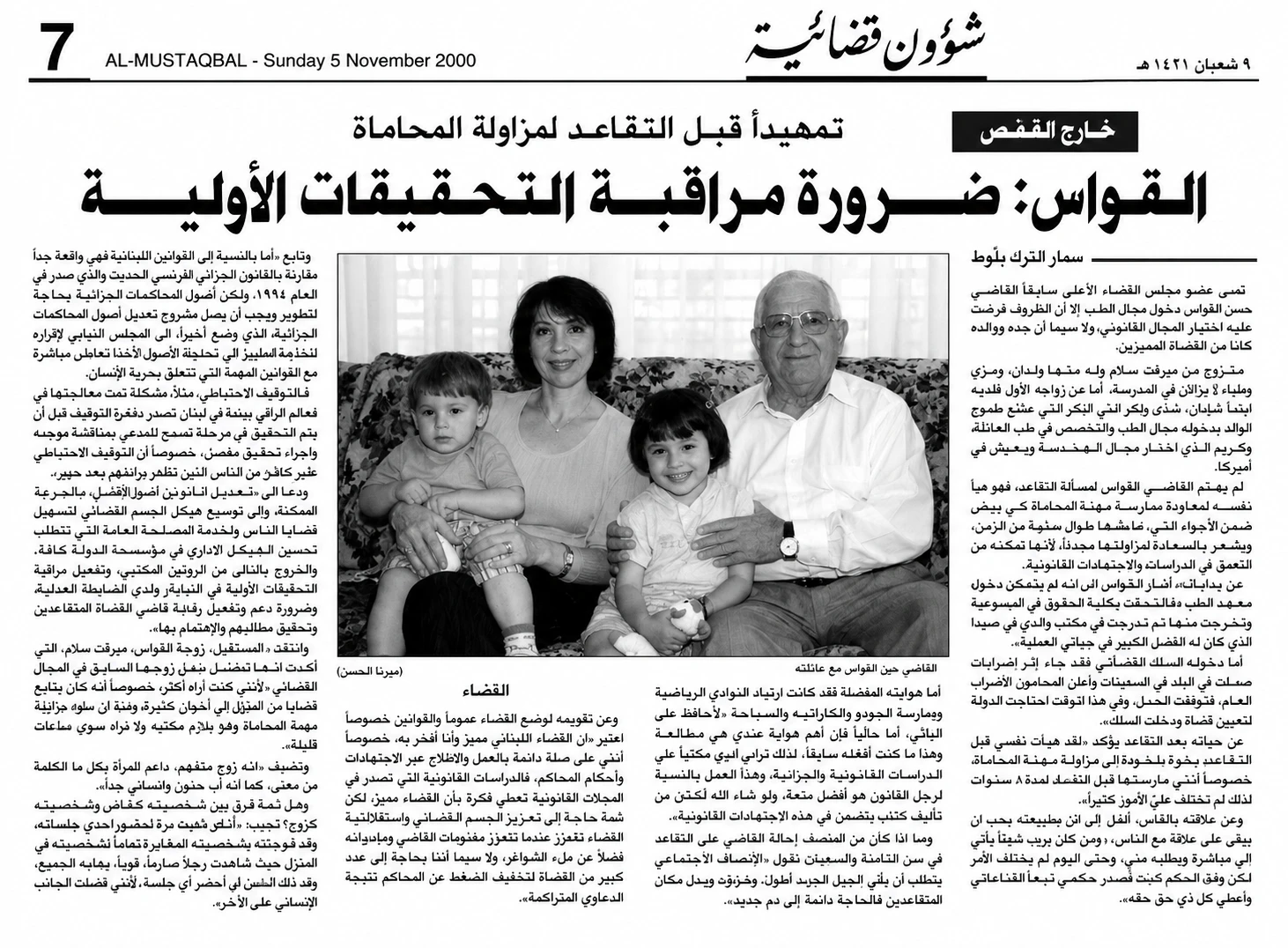
A judge who changed position from inside the system
Kawas became publicly associated with arguments against capital punishment. A death-penalty source cites his article titled, in translation, 'Execution does not achieve justice, and demanding its abolition is a civilized phenomenon.'
The strongest point is biographical and moral: he had been a murder-court judge who issued death sentences, then changed position after concluding that execution did not reduce criminality.
Human rights, civil peace, and judicial independence
On December 11, 1990, Kawas spoke at a Human Rights in Lebanon seminar in Saida, linking rights to conscience, justice, freedom, equality, and dignity.
His later public record also connects him with civil peace, secularism, freedom of opinion, and collective judicial action for a judiciary treated as an authority rather than a mere administrative function.
Sources and context
- Fighting against the Death Penalty in the Arab WorldWorld Coalition Against the Death Penalty · 2010-02 · Research report · PDF
See the Lebanon discussion and note 113 on printed page 57, citing Kawas’s An-Nahar article of 30 May 2003. This is a bibliographic citation, not the original newspaper page.
- Hassan Kawas’s tribute to Judge Wajih AlawiyehAs-Safir · 1996-01-11 · Writing by Hassan Kawas
The source of the short quotation in the opening screen; the English, French and Russian versions translate the Arabic excerpt.
- Hassan Kawas : le droit et la droitureL’Orient-Le Jour · 2013-08-15 · Tribute by Antoine Messarra
A personal tribute discussing civil peace, the rule of law and the public memory of Kawas.
Compiled by Judge Hassan Kawas Archive. Updated . How we use sources.